Mitsubishi Polyester Film GmbH

HOSTAPHAN™ Technical Properties

HOSTAPHAN™ is a film that consists of polyethylene terephthalate (PET) with outstanding physical characteristics. It is biaxially drawn and heat-set.

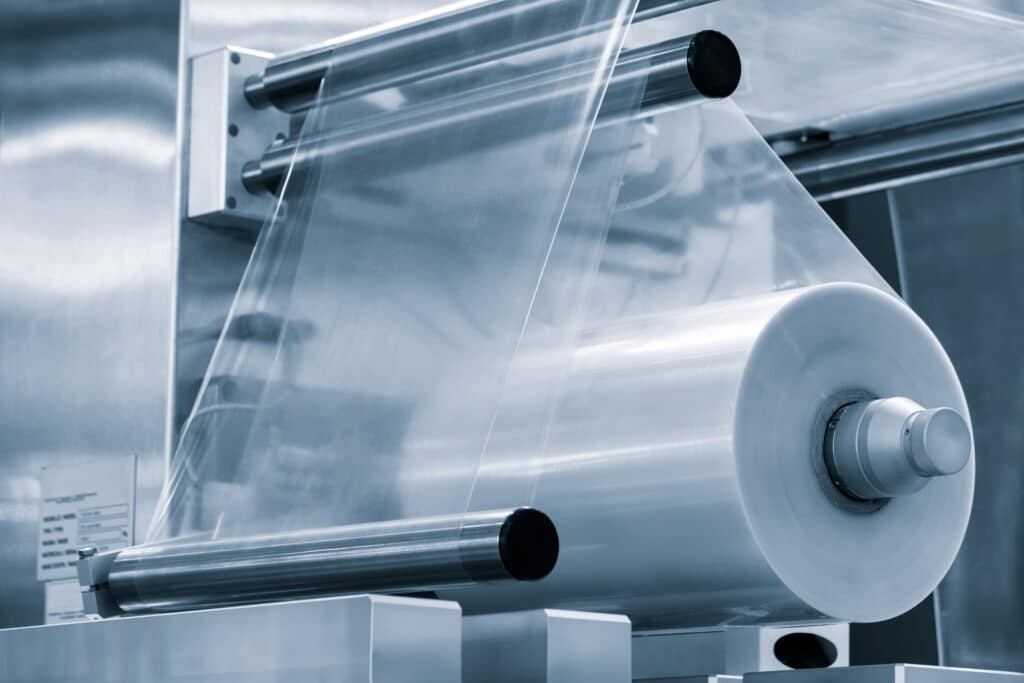
Plastic film production machine with a rolled transparent film in an industrial environment

Contents

Excellent Properties

Because of these excellent properties, HOSTAPHAN™ is truly versatile:

  • extremely high tensile strength and tear resistance
  • impact and abrasion resistance
  • dimensional stability
  • resistance to heat and cold
  • excellent suitability for printing, metallisation and lamination
  • good barrier to aromas, gases and water vapour
  • resistance to common organic solvents, oils, greases and many inorganic substances
  • resistant to mould and bacteria
  • freedom from plasticisers, odours and flavours
  • base material suitable for food contact (details on request)
  • excellent electrical insulation
  • available with a variety of physical properties and surfaces

Mechanical Data

Units Typical Values * Test Standard Test Conditions
Flexing cycles ./. > 100 000 ./. ./.
Edge tear resistance MD N 150 DIN 40634 23°C, 50% rel. Feuchte
TD N 150 DIN 40634 23°C, 50% rel. Feuchte
Coefficient of friction ./. 0,4 DIN 53375 23°C, 50% rel. Feuchte
Impact resistance MD mJ/mm² 1400 DIN 53448 23°C, 50% rel. Feuchte
TD mJ/mm² 1800 DIN 53448 23°C, 50% rel. Feuchte
Tear propagation strength MD N/mm 240 DIN 53363 23°C, 50% rel. Feuchte
TD N/mm 240 DIN 53363 23°C, 50% rel. Feuchte

Electrical Data

Units Typical Values Test Standard Test Conditions
Electrolytic corrosion effect ./. A1 DIN 53489 or VDE 0303/ part 6 ./.
Behaviour under the influence of glow discharges on surfaces (measured on films of thickness 36 µm) min 900 DIN 53485 or VDE 0303/ part 7 Contact method 40kV / mm
Mandrel Test ./. one-layer (RN 100) 3-layer (RN 23, RN 50) EN 61558-1/1997 Section 26.3 ./.

Dimensional stability

Units Typical Values Test Standard Test Conditions
Moisture expansion coefficient (%r.h.) -1 0.7 x 10 -5 In-house method 40 - 80% r.h.
Coefficient of linear thermal expansion K -1 2 x 10 -5 In-house method 20-50°C
Dimensional stability under pressure with rising temperature °C 240 DIN 40634 or VDE 0345 ./.
Dimensional stability under tension with rising temperature °C 240 DIN 40634 oder VDE 0345 ./.

Optical Data

Units Typical Values Test Standard Test Conditions
Refractive index ./. 1.6 DIN 53491 l=589nm, 25°C

Thermal Data

Units Typical Values Test Standard Test Conditions
Flammability (no flammable gases occur up to.) °C 400 DIN 40634 or VDE 0345 ./.
Low temperature resistance °C -196 DIN 53372 tested to -196°C
Specific heat J/kg x K 1300 ./. ./.
Heat conductivity W/m x K 0.13 VDE 0304/part1 ./.
Approved insulating class for electrical machinery ./. B DIN 57530 oder VDE 0530/Hauptliste ./.
Heat of Combustion kJ/kg 25 000 DIN 5190 ./.
Vicat-Softening temperature °C > 230 DIN EN ISO 0306 Method B 50

Physcial and Chemical Data

Units Typical Values Test Standard Test Conditions
Frigen-extract®, measured on films RN and WN 190 % 0.05 DIN 8944 Cold extraction
Conductivity of aqueous extract µS/cm 2 DIN 40634 or VDE 0345 1 kHz
Trichloroethylene extract, measured on films RN and WN 190 % 0,2 DIN 8943 Extracted in Soxhlet apparatus for 2h. Boiled down for 15h at 105°C.

Permeability

Aromas Units Typical values * Test standard Test conditions
Campher g/m ² x d < 3 x 10 -6 In-house method 20°C
Diphenylmethane g/m ² x d 4 000 x 10 -6 In-house method 20°C
Eugenol g/m ² x d 160 x 10 -6 Interne Methode 20°C
Eucalyptol g/m ² x d 8 000 x 10 -6 In-house method 20°C
Geraniol g/m ² x d 130 x 10 -6 In-house method 20°C
Menthol g/m ² x d 700 x 10 -6 In-house method 20°C
Vanillin g/m ² x d 10 x 10 -6 In-house method 20°C
Cinnamaldehyde g/m ² x d 50 000 x 10 -6 In-house method 20°C
Vapours
Acetone g/m ² x d < 0,1 In-house method 23°C
Benzene g/m ² x d < 0,1 In-house method 23°C
Ethanol g/m ² x d 0.005 In-house method 23°C
Ethyl acetate g/m ² x d < 0,1 In-house method 23°C
Formaldehyde (30% solution) g/m ² x d 0.003 In-house method 23°C
Hexane g/m ² x d < 0,1 In-house method 23°C
Methanol g/m 2 x d 0.7 In-house method 23°C
Carbon disulphide g/m ² x d 3 In-house method 23°C
Carbon tetrachloride g/m ² x d 0.2 In-house method 23°C
Water g/m ² x d 8 DIN 53122 23°C
*) measured on HOSTAPHAN RN 25
Gases Units Typical Values * Test Standard Test Conditions
Ammonia, trocken cm3 /m² x d x bar 4 000 In-house method 23°C
Argon cm3 /m² x d x bar 25 DIN 53380 23°C
Hydrogen cyanide cm3 /m² x d x bar 8 000 DIN 53380 23°C
Chlorine cm3 /m² x d x bar 60 DIN 53380 23°C
Ethylen oxide cm3 /m² x d x bar 650** In-house method 23°C
Frigen 11 cm3 /m² x d x bar < 4** DIN 53380 24.5°C
Frigen 12 cm3 /m² x d x bar 12** DIN 53380 20°C
Frigen 13 cm3 /m² x d x bar 14** DIN 53380 20°C
Frigen 21 cm3 /m² x d x bar 7** DIN 53380 20°C
Frigen 22 cm3 /m² x d x bar 7** DIN 53380 20°C
Frigen 114 cm3 /m² x d x bar 6** DIN 53380 20°C
Frigen 502 cm3 /m² x d x bar 6** DIN 53380 23°C
Helium cm3 /m² x d x bar 2 000 DIN 53380 23°C
Carbon dioxide cm3 /m² x d x bar 240 DIN 53380 23°C
Air cm3 /m² x d x bar 30 DIN 53380 23°C
Methyl bromide cm3 /m² x d x bar 50 DIN 53380 23°C
Phosgene cm3 /m² x d x bar 50 DIN 53380 23°C
Oxygen cm3 /m² x d x bar 70 DIN 53380 23°C
Sulphur dioxide cm3 /m² x d x bar 1 000 In-house method 23°C
Hydrogen sulfide cm3 /m² x d x bar 500 In-house method 23°C
Nitrogen cm3 /m² x d x bar 20 DIN 53380 23°C
Hydrogen cm3 /m² x d x bar 1 100 DIN 53380 23°C
*) Measured on Hostaphan™ RN 25. Unless otherwise indicated, the values have been converted for normal pressure and temperature. **) Values not converted to reflect normal conditions.

Physical and Chemical Stability

Aldehyde Acetaldehyde resistant
Formaldehyde resistant
Alcohols Benzyl alcohol partially resistant
Cyclohexanol resistant
Ethanol resistant
Diol resistant
Glycerol resistant
Isopropyl alcohol resistant
Methanol resistant
Chlorinated hydrocarbons Chlorinated biphenyls partially resistant
Chloroform resistant
Carbon tetrachloride partially resistant
Trichloroethylene resistant
Esters Ethyl acetate resistant
Hydrocarbons Aliphatic hydrocarbons resistant
Gasoline (petrol) resistant
Benzene resistant
Mineral oils resistant
Toluene resistant
Xylene resistant
Acids 50% formic acid resistant
Acetic acid (any concentration) resistant
10% and 35% hydrofluoric acid resistant
Phosphoric acid 30% and 85% resistant
10% nitric acid resistant
65% and 100% nitric acid not resistant
10% hydrochloric acid resistant
30% hydrochloric acid partially resistant
Sulphur dioxide gas, dry resistant
20% sulphuric acid partially resistant
80% and above sulphuric acid not resistant
Salt solutions Alkaline carbonates resistant
Bichromates resistant
Cyanides resistant
Fluorides resistant
Other organic solvents Acetone resistant
Diethyl ether resistant
Nitrobenzene not resistant
Phenol not resistant
Miscellaneous substances Chlorine resistant
Oxygen resistant
Water* resistant
Hydrogen peroxide resistant
Alkaline solutions Ammonium hydroxide not resistant
Calcium hydroxide partially resistant
Sodium hydroxide not resistant
*) At elevated temperatures (approx. > 100°C) and in the presence of water (vapour), polyester films such as HOSTAPHAN™ tend to become brittle as a result of hydrolysis.

Reel Cores


Core material Applications /width Inner diameter /mm
Cardboard core for general applications 152.4
Cardboard core large width from approx. 2000 mm 200
Phenolic resin impregnated and polished paper ultra thin film for capacitors150
Polystyrene core capacitors 150

Film yields

Thickness µm Weight g/m ² Yield m ² /kg
6.0 8.4 120.0
8.0 11.0 90.0
10.0 14.0 72.0
12.0 17.0 60.0
15.0 21.0 48.0
19.0 27.0 38.0
23.0 32.0 31.0
25.0 35.0 29.0
30.0 42.0 24.0
36.0 50.0 20.0
50.0 70.0 14.0
75.0 105.0 9.6
96.0 134.0 7.5
100.0 140.0 7.2
125.0 175.0 5.7
175.0 245.0 4.1
190.0 266.0 3.8
250.0 350.0 2.9
300.0 420.0 2.4
350.0 490.0 2.0
500.0 700.0 1.4
*) valid for film types with a density of 1.4 g/cm3

Storage Conditions

The polyester film HOSTAPHAN™ is largely unaffected by climatic influences.

We recommend that the film is kept in the original packaging until used.
A dry dust-free storage room with an ambient temperature below 30°C is of advantage.

Avoid storing the film outdoors for any significant period of time where it will be exposed to harmful influences such as humidity or direct sunlight. The film should be transferred, in the transport packaging, to the processing area or a room with a similar climate at least 24 hours before processing.

We recommend removing the film from the original packaging immediately before processing. After removal, transporting the film roll by means of a steel bar through the core will prevent deformation or damage to the outer layers.

Short-term storage in polystyrene throughs is also an option with HOSTAPHAN® films with a thickness equal or greater than 36 µm. We know of no restriction to the shelf-life of HOSTAPHAN®. Nevertheless, we recommend that the film is processed within a year of delivery.

Note

This information provided here is consistent with the current state of our knowledge and is intended to provide general information on our products and their applications. It does not constitute a guarantee of any specific product attributes or the suitability of products for specific applications. Any existing commercial rights or patents must be observed. We guarantee full product quality under the terms of the General of MITSUBISHI POLYESTER FILM GmbH

Contacts

Our sales representatives are happy to answer any questions you may have.

For detailed technical information, please contact us.
We would be pleased to advise you.